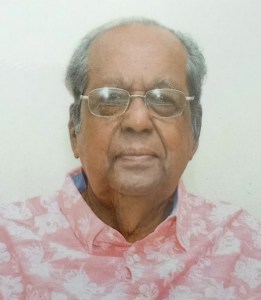
Dr Indra Mohan Prasad ( November 5, 1931- December 9, 2024)
For citizens of the steel city, Jamshedpur (a city whose dream was weaved by Jamshetji Tata but which was turned into a reality in 1907 by the untiring efforts of his elder son Doarabji Tata) the name Dr. I. M. Prasad needs no introduction. For decades any citizen of Jamshedpur whether walking, cycling, or zooming past in his scooter (Jamshedpur in his heyday was a city of scooters), or an odd car knew of a milestone, minimalistic modest home, with a bright neon sign with the name “Dr I. M. Prasad,” on the Sakchi end of the Straight Mile road
It was one of the few TISCO quarters allotted to a non-Tata person.
Dr. Prasad was no celebrity. He was just an ordinary man who led an extraordinary life. When he died, he was one of the oldest and most respected doctors in the combined states of Bihar and Jharkhand. Until his death, he was the patron of the Indian Medical Association (IMA) and Ophthalmological Society of Jamshedpur, and he was feted and emulated in life.
Dr Nandwani who declared his death, summed it up aptly- “He was a Pillar of Jamshedpur”
STEEL CITY DREAM CITY
In 1967, when Dr. Prasad alighted at Tata Nagar station from Patna, Jamshedpur, the city that Dorabji Tata built was celebrating its 60 years of birth. And what a dream city it was. Below I describe the dream of the steel way Jamshetji Tata founded the Tata group weaved in a letter written in 1902 to Dorabji Tata his elder son-
(Quote)‘Be sure to lay wide streets planted with shady trees, every other of a quick-growing variety. Be sure that there is plenty of space for lawns and gardens. Reserve large areas for football, hockey, and parks. Earmark areas for Hindu temples, Mohammedan mosques, and Christian churches.’ (Unquote).
Exactly sixty-five years after this letter from Jamshetji to Dorabji in 1967, young Dr. Prasad arrived in the steel city full of youthful dreams. He instantly fell in love with its warmth and grandeur and made it his home. From 1967 to his death in 2024, Dr. Prasad lived and worked in Jamshedpur except for a brief period of a few months when he was posted as Professor and Head of the Department of Opthalmology, Nalanda Medical College and Hospital Patna
I will return to this story a bit later.
DREAMER TO THE CORE
Dr. Prasad since his early life was a dreamer to the innermost core. He was also an avid sportsperson, in love with the game of lawn tennis, a love he acquired from his civil servant father Bansi Prasad (who died prematurely in 1947). His career choice was largely determined by the dream of his mother who was zealous of family unity and wanted her five sons to choose five different vocations. With his two elder brothers already in police service, and civil service, and highly impressed by his youngest uncle (civil surgeon of Patna around independence) he chose to be a doctor. Two younger brothers of Dr. Prasad chose to join the Indian Forest Service (IFS) and the Indian Engineering Service (IES).
Having chosen the profession his career blossomed soon. He acquired his M.B.B.S. degree from Prince of Wales Medical College, as he loved to call his alma mater PMCH ( Patna Medical College & Hospital), followed by twin postgraduate degrees MS (ENT) and second MS (Ophthalmology) both from PMCH.
His mentor in the medical profession was legendary Dr. Dukhan Ram who played an extraordinary role in making and shaping his early career.
IN THE FOOTSTEPS OF HIS ILLUSTRIOUS MENTOR
Dr. Prasad started his medical career under the mentorship of India’s leading eye surgeon Padma Bhushan Dr. Dukhan Ram ( Honorary Ophthalmic Surgeon to the first five Indian Presidents). Early in his career, Dr. Prasad had a life-changing moment –
“In 1957 at the age of 26 he was one of the two chosen doctors by Dr Dukhan Ram (the other being the latter’s son) to assist him in performing the cataract surgery in Rashtrapati Bhavan of Dr. Rajendra Prasad first President of India”.
From his mentor Dr. Dukhan Ram, Dr. Prasad imbued diagnostic skills, proficiency as an ophthalmic surgeon, and more importantly the penchant to serve the poor. It is instructive for the readers to know why and how Dr. Dukhan Ram developed deep empathy to serve the poor. Dr. Ram himself was born into a very poor family in Sasaram of Bihar, and his medical education was largely funded by scholarships from a few individual donors. In fact, one person who liberally gave scholarships to both for school and medical education to Dr. Ram was none other than my own grandfather Yugal Kishore Sahay.
Dr. Prasad had no such compulsion. He was born into an illustrious Kayastha family in Bihar. His father had three brothers, their Mokhtar father Mahavir Prasad sent all four of his sons- Devi Prasad, Mathura Prasad (later Rai Bahadur Mathura Prasad Sinha, Bansi Prasad, and Ganpat Prasad- to the famous Presidency College of Calcutta for education. Three brothers Devi, Mathura, and Bansi chose to become civil servants in the British era while the youngest Ganpat Prasad turned into a fine doctor who passed out from Calcutta Medical College.
Dr. Prasad fondly used to tell me two stories about his father Bansi Prasad, third of four brothers-
One, in the footsteps of Dr. Rajendra Prasad, the first President of India Bansi Prasad was the second Bihari after Dr. Rajendra Prasad, (the first President of India) to become prefect of the best hostel of the Presidency College.
Two, the interview with the British Governor: after his graduation Bansi Prasad chose to be a civil servant. But it was the early 1930s each year few were selected in the country as I.C.S. officers, there was no service known as I.A.S but every year the British Governor of Bihar (then combined state of Bihar, Orissa, and Jharkhand) recruited one/two Deputy Collectors after personally interviewing them.
When the turn of Bansi Prasad came for the interview to be selected as Deputy Collector, the British Governor asked him only one question – ” I have already recruited your two elder brothers, Devi Prasad and Mathura Prasad as Deputy Collector in two previous years, why should I select a third this year from the same family”. Bansi Prasad foxed the British Governor with his answer- “Your Excellency, I understand you select a Deputy Collector’ based on merit and competency, lineage should not play any role in that”
That was it. Bansi Prasad was a true nationalist, he wore dhoti-kurta and ate sitting on the floor. His elder brother Mathura Prasad true to the way civil servants were supposed to live in British India, lived life king-size, with a kitchen full of butlers and food served on the dining table in style. British denied promotion to Bansi Prasad and he died collapsing immediately after a game of tennis while posted at Gaya. Mathura Prasad was given the rightfully earned title “Rai Bahadur” by the British, was promoted to IAS after independence, and died as “Rai Bahadur Mathura Prasad Sinha I.A.S.” with a road in the city name after him. There is a famous story about Mathura Prasad who was collector cum District Magistrate of the Shahabad district of Bihar, in 1942 he refused to give permission to the British Superintendent of Police to open fire on agitating freedom fighters
After the untimely death of Bansi Prasad, his illiterate but full of wisdom highly educated better half Sushila Devi, instilled values, virtues of simple living, and service orientation to their five sons and four daughters. It is unsurprising then that Dr. Indrta Mohan Prasad himself lived a simple minimalist life but, lifted his service orientation to such a high level, that before the states of Bihar and Jharkhand were separated, he was felicitated by the Governor of Bihar, for performing the highest number of free cataract surgery to the poor in the state
AN ICON LOVED AND RESPECTED BY ALL
In the steel city of Jamshedpur to be somebody you have to be a top honcho in one of the two main Tata companies based there- TISCO (now Tata Steel) and TELCO (now Tata Motors). And if you are a doctor, who does not belong to the famed Tata Main Hospital (TMH), you are a rank outsider, an absolute non-entity.
Indubitably, it was a scary landscape for young, 36-year-old Dr. I. M. Prasad, a rank outsider when he landed at Jamshedpur. But the wall of the steel city broke soon. Dr. Prasad as a doctor lived the code of ethics the “Hippocratic oath” in both letters and spirit. He believed in all key edicts of “doing no harm, doing good, being ethical, serving God through his patients and serving poor”.
He was also one of the finest orators and story-tellers I have seen in life
He descended at Jamshedpur in 1967 as an Assistant Professor (ophthalmology) at Mahatma Gandhi Medical College (MGMof ) and Hospital, Jamshedpur. To be respected in the city then, one had to be a reputed doctor at Tata Main Hospital. No less. But in a few years, simple and affable Dr. Prasad with his competence, professional acumen, simple living, and diagnostic skills endeared him to all in the steel city irrespective of the strata of the society.
In daytime, he provided service to his patients, in the evening he was the life of the tennis club of United Club where he rubbed shoulders with who is who of Tata Steel, and bureaucrats and police officers serving in the city became his personal friends. The love, affection, and respect of Jamshedpur residents of Fr. Prasad in the coming decades spread like wildfire.
And within no time he became an icon in the steel city
It is difficult to put into words how he touched the lives of lakhs of Steel City residents,. I can recount tens of thousands of such stories from my personal remembrance but that is beyond the scope of this memoir. So I present here a few selected representative stories-
- Minimal Fee, Maximum Service- The most important attribute of Dr. Prasad was that he charged his minimum fees from his patients but provided them maximum care. Stories are legion of his treating the poor absolutely free, who could not afford even his minimal fees. He had the option to live life king size in a palatial bungalow in the upmarket Circuit House Area of Jamshedpur but chose to spend the better part of his life in a modest two-bedroom accommodation provided to him by Tata Steel despite not being a Tata Employee.
- Reverred by his Patients- He had extraordinary trust and abiding faith of his patients, who came not only from the city of Jamshedpur and its out skirts also from the neighbouring and far off districts of Jharkhand, Bihar, Orissa and West Bengal. Their trust was of such monumental proportion that when Dr Prasad was outside Jamshedpur the patients would wait for his return instead of going to some other doctor.
- Uncompromising Ethics and Values: Once he retired he faced a quandary where to see his patients. Someshedpur then had a practice, city chemists’ shop, and spectacles shops that provided free space to doctors for patient consultation which increased sales of their medicines and spectacles. Dr. Prasad had plentiful offers but he refused them. Instead, he chose the option of a respected physician Dr. Mukherjee who was alloted the house by TISCO after the retirement of Dr. Prasad. To give credit to Dr. Mukherjee for the next decade, he made sure that Dr. Prasad treated his patients from the same old small clinic he had treated for four decades, while Dr. Mukherjee saw his own patients in a makeshift place attached to the garage. With advancing age, Dr. Prasad stopped treating patients three years back, but his last patient came looking for him at his Jamshedpur home one day before his death before he passed away a few days into his 94th year
- Say No to Injustice and Bigger No to Corruption- Once he was driven to the wall he went against the not-so-sanguine government of Dr. Jagganath Mishra up to the Supreme Court. Also when the post of Superintendent at MGM Hospital was a hotbed of corruption before and after him but he kept his tenure swanky and clean
- He was God to railway coolies of Tata Nager Railway Station-After I got married to his younger daughter in 1987, every time we would come to Jamshedpur from my far-off postings in Indian Railways, he would personally come to Tata Nagar railway station to receive us. At his mere sight, there would be competition among railway station coolies, to pick up our luggage. The lucky one invariably refused to take money for his service. Railway coolies revered him because they were treated free by him including performing free cataract surgery.
- Story of a police constable– In 1991 purely due to his goodwill marriage of my younger sister was fixed without any demand of dowry with one of the sons of his friend (then the superintendent of MGM Hospital). When the question of preparing traditional bamboo mandap for marriage cropped up, from nowhere came a police constable and took the responsibility that too at his own cost refusing to take money. When the police constable risked losing his vision in both eyes and his job owing to his both eyes were saved through two sequential surgeries by Dr. Prasad. As the police constable did not have money, he not only performed surgery free of cost but each time gave a Rs. 250 charges for administering anesthesia to the assisting doctor from his own pocket.
- Favorite doctor of missionary fathers and Mothers: The best academic institutions in Jamshedpur are Tarta assisted two Jesuit educational institutions Loyola School (for boys) and Sacred Hearth Convent (for Girls). Notwithstanding that two daughters of Mr. Prasad studied in Sacred Heart convent and the son studied in Loyola school, irrespective of the type of ailment of fathers and sisters, throughout his professional careers Dr. Prasad was their single window expert. And throughout his life, he refused to take any fee from them. This led to the bond blossoming much beyond that of the patient-doctor relationship.
- Comrade of a legend: V. G. Gopal: President of Tata Worker’s Union, and a trade union of international repute V. G. Gopal used to command respect in Jamshedpur next only to Russi Mody, the legendary CMD of Tata Steel.. Gopal was equally close to and respected by JRD Tata. Under the Russi-Gopal era, TISCO and other Jamshedpur companies were examples of world-famous industrial harmony. Gopal could command any doctor of Tata Main Hospital Jamshedpur to his home but one day he reached the modest home cum clinic of Dr. Prasad with his wife. No doctor in the country was able to cure the serious eye ailment of Gopal’s wife. Under Dr. Prasad’s watch, Gopal’s wife was fully cured in less than a month. With that began a friendship that was cut short only with the sudden unfortunate death of V G Gopal in 1993
- A Friendship for Life : P N Shankaran -international sports was brought to Jamshedpur by Tata Steel. Irrespective of the game, the responsibility of sporting events at Jamshedpur fell squarely on the shoulder of multifacet Shankaran as senior Tata School. Even today in his late eighties he can be seen turbocharging Marathons in Mumbai, Delhi, and other key cities. A devout Shankaran also is attributed to be the founder, chief priest, and acting president of the famous Sri Uttara Sabarimala Dharma Saastha Temple at Jamshedpur. The relationship between Dr. Prasad and Mr. Shankaran though not very warm in the first year, soon became inseparable congenital twins particularly when Dr Prasad forced Shankaran to immediately leave Jamshedpur and get treated at Madras when he faced life life-threatening illness. During the last months of Dr. Prasad, Shankaran dashed more than once from Bengaluru where he lives now, got special puja done at the temple, and called almost daily. Such was the legend of the friendship of the two.
A COMPLETE FAMILY MAN
With five brothers and four sisters, Dr. Prasad had a large extended family. It became much larger after his marriage. When it came to medical emergencies he was go-to man person of first resort for the family and friends across generations. It is difficult to do justice to this part of the humaneness of Dr. Prasad but there was no occasion when there was a family emergency in which he was not at the forefront of battling both the illness as well as calming the family.
TENDING TO MY UNHINGED MIND
How can I end this piece without writing how he “brought back my unhinged mind to sanity” and gave me a “second life“. I was married on January 20, 1987 to his second daughter Shamila nicknamed Linky at Lala Lajpar Rai Bhawan Patna. Less than eleven years after that in November 1997 when Linky was visiting her parents at Jamshedpur I had “my major depressive attack” at Essar House, Mahalaxmi where I had joined a few months back after an immensely satisfying government career whose highlight was “Financial Engineer of complex crucial nation’s marquee project- Konkan Railway”. Linky rushed back to Mumbai where I had two mental breakdowns first in February 1998 gave me the diagnosis of Major Depressive Disorder (MDD) but the second breakdown in “September 1998” got me the life sentence of Manic Depressive Insanity now secularly known as Affective Bipolar Disorder – I”. It was followed by multiple unhinged manic attacks starting in 2000.
I will not burden readers with the story of my “unhinged madness” filled with multiple episodes of the abyss of dystopic depression and flame out of hurricane mania ( that is chronicled in various newspaper stories and TV programs), but suffices to say that unfettered services he rendered to reclaim my mind back have few parallels back (ably supported by Linky, his elder sister Rashmi, younger brother Manish and my mother in Law Dr. Veena Prasad). He treated my condition strictly as an illness, sequestered our two sons from me during the period, helped me get re-educated at the Asian Institute of Management Manila, took care of me at his Jamshedpur at my worst, and most importantly gave me the confidence to “stand back on my feet”.
I had the immense satisfaction i getting the opportunity to stay with him during his last days and he breathed last peacefully at Jamshedpur home with me in attendance with folded hands.
I am also lucky to be writing this piece from my makeshift workstation, at Jamshedpur home, writing his obituary using the same desk and chair, from where he treated his patients with love, care and compassion rarely seen in doctors of this era.
We as a family will be celebrating his life with the final Havan Puja and Havan on December 14.
He lived a full life like few get the opportunity and left behind his wife Dr. Veena Prasad, formerly Professor and Head of Department, Gynaecology MGM Medical College, Children Rashmi, Linky, Manish their spouses ( Rajendra Verma, me, and Sumi Mohan), grandchildren ( Aunany -Jyoti, Rachit, Rohit- Yuktie, Anurag- Ishani, Mayank and Suyash in the order of age) and one great-grandchild Advik
(Written By Akhileshwar Sahay, Jamshedpur, December 11, 2024
 AKHILVAANI LIVING IT UP